
Economy Commentary
The Economy
A Firmer Floor Under (Most Of) The Economy
October 2026
The Bureau of Economic Analysis recently released the results of their annual revisions to the data from the National Economic Accounts (NEA). The NEA provide a comprehensive view of U.S. economic activity and are the root source of the BEA’s estimates of GDP, personal income, corporate profits, and a host of other national and regional data series. Each year the BEA undertakes revisions to the data from the NEA, which vary in terms of scope and duration; this year’s revisions cover the period from Q1 2021 through Q2 2026. On the whole, the revised data show the U.S. economy, at least most of it, on firmer footing heading into 2H 2026 than previously implied.
Real GDP is now shown to have increased by 17.4 percent from Q1 2021 through Q2 2026, as opposed to the 16.7 percent increase previously reported. The larger net increase in real GDP is pretty evenly split between a slightly larger increase in output and a slightly smaller increase in prices over this span. Real GDP is now shown to have grown by 3.0 percent in 2024 and by 2.3 percent in 2025, compared to the prior estimates of 2.8 percent and 2.1 percent, respectively. The upward revisions go hand in hand with the data showing an accelerating trend rate of labor productivity growth in place well before AI came to dominate the discussion.
One element of the revised GDP data we found of particular interest is that an upward revision to business investment spending is the primary driver of the upward revision to real GDP growth. Real business fixed investment grew by more from Q1 2021 through Q2 2026 than previously reported, with larger gains in each of the three main components – structures, equipment and machinery, and intellectual property products. One caveat, however, is that the growth in business spending on structures over this period is almost entirely a function of the burst of factory construction from late-2022 through mid-2024 fueled by the “CHIPS and Science Act,” outside of which commercial construction activity has been notably weak. The obvious exception is construction related to data centers, which lent support to the Q2 2026 data, and which will make a bigger impression on structures spending going forward.
The impact of AI related investment is apparent in the data on business investment in equipment and machinery. Business spending on computer equipment and communications equipment has been notably strong over the past several quarters, reflecting surging AI-related investment, but at the same time growth in business spending on equipment and machinery has become much more broadly based. This to some degree reflects the impact of changes in the corporate tax code enacted into law in the summer of 2025, particularly the provision allowing for immediate expensing of such investment. The higher frequency data on core capital goods orders (i.e., nondefense capital goods excluding aircraft and parts), a very early indicator of the GDP measure of business investment, suggest business spending on equipment and machinery will remain a meaningful support for real GDP growth for several quarters to come.
The revised data also show faster growth in real business investment in intellectual property products than previously reported. Intellectual property products mostly consist of outlays on computer software and research & development, and spending in these areas heavily impacts labor productivity growth over time. To that point, growth in spending on intellectual property products has for some time tended to outpace growth in the two other broad components of total business investment. This consistent growth presaged the pickup in the trend rate of labor productivity growth that has for some time been apparent in the data.
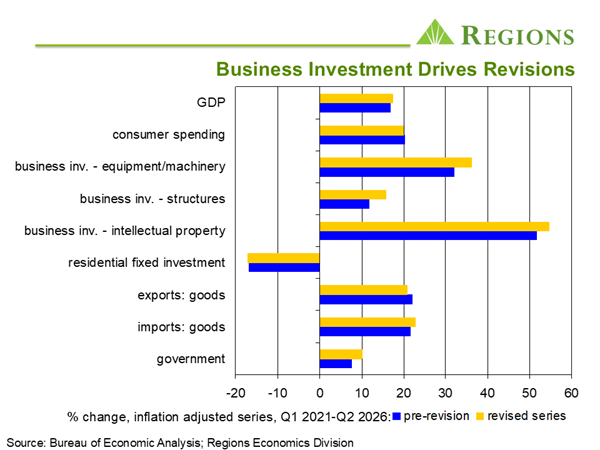
Another sign of the strength in business investment spending over recent years is the growth in imports of non-automotive capital goods – goods ultimately used by companies in the U.S. in the production of final goods. The revised data show total imports of goods, adjusted for price changes, grew by 22.7 percent from Q1 2021 through Q2 2026, up from the initial estimate of 21.5 percent, with an upward revision to imports of non-automotive capital goods the primary driver.
One area in which the revisions to the recent historical GDP data were not kind is residential fixed investment, now shown to have contracted by 17.1 percent from Q1 2021 through Q2 2026 rather than by 16.9 percent as previously reported. The downward revision would have been harsher had it not been for single family residential investment expanding at a faster pace in Q2 2026 than had previously been reported. That, however, won’t last for long as single family construction slipped in Q3 2026 and we look for it to slip further over the final quarter of this year, while multi-family activity is flat to slightly lower. We expect residential fixed investment to be a drag on real GDP growth through 2027.
On the whole, the upward revisions to the various components of business fixed investment and imports of non-automotive capital goods suggest a firmer foundation for overall economic growth over coming quarters than had already been implied in the GDP data. To be sure, the ultimate extent of and timing of the payoff from AI-related investment cannot be known, but the strength in business investment spending is benefiting current real GDP growth while laying the groundwork for faster future growth. At present, however, the revised GDP data do not alter the point we made in last month’s edition, which is that real GDP growth has settled back into the trend pace seen over the course of the pre-pandemic expansion while nominal GDP growth not only remains well above the pre-pandemic trend rate but has accelerated over recent quarters, a reflection of prices rising at a faster pace.
Though expectations of faster real GDP growth down the line brought about by current business investment spending may be playing a role, the recent run-up in market interest rates seems far more a function of the acceleration in nominal GDP growth amid trend-like real growth. This combination is keeping the FOMC in play even after the twenty-five basis point hike in the Fed funds rate at their September meeting. Though remaining in play, any sense of urgency around subsequent hikes in the funds rate seems to have faded in the wake of recent data releases.
Specifically, the BEA recently introduced methodological changes in the calculation of the PCE Deflator, the FOMC’s preferred gauge of inflation. These changes had the net effect of lowering core PCE inflation by twenty-to-thirty basis points over the past several quarters. To be sure, this still leaves core PCE inflation, at 3.0 percent as of August, handily above the FOMC’s 2.0 percent target at a time when rising energy prices are pushing headline inflation higher. That said, the revised data show a shallower trajectory of core PCE inflation than had previously been reported, which many market participants see as giving the FOMC some breathing room as they deliberate the appropriate policy path.
The September employment report is also seen as diminishing any sense of urgency around further funds rate hikes. Total nonfarm payrolls rose by 29,000 jobs in September, with private sector payrolls up by 46,000 jobs and public sector payrolls falling by 17,000 jobs. Prior estimates of job growth in July and August were revised sharply lower, with 81,000 fewer private sector jobs added over the two-month period than previously reported. Average hourly earnings rose by just 0.1 percent, leaving them up 3.0 percent year-on-year, while aggregate private sector wage and salary earnings rose by 0.2 percent, translating into an over-the-year increase of 4.2 percent. Thanks to a second straight monthly increase in the labor force participation rate, the unemployment rate ticked up to 4.2 percent, while the broader U6 measure, which also accounts for underemployment, fell to 7.6 percent.
While many are assessing the September employment report in terms of what it may mean for the FOMC, our assessment revolves around just two numbers. First, the initial response rate for the September establishment survey was just 53.1 percent, well below depressed post-pandemic rates and the lowest September response rate since 1987. A rate this low calls into question the reliability of the initial estimates of nonfarm employment, hours, and earnings in September, and could lead to larger revisions than would have been the case with a higher response rate.
Second, over the twelve months ending with September, not seasonally adjusted private sector payrolls increased by an average of 60,167 jobs per month, right in line with the trend rate that has prevailed since early 2025. This is, to us, the most relevant data point that can be pulled out of the September employment report. While the estimates of monthly job growth on a seasonally adjusted basis have been all over the map, the underlying trend rate of job growth in the not seasonally adjusted data has been notably stable. Though well lower than what we were accustomed to over the years prior to the pandemic, this trend rate is nonetheless more than adequate to keep the unemployment rate in check given what is much weaker labor supply growth.
A stable but not necessarily strong labor market is freeing the FOMC to make inflation their main focus. This, of course, does not mean the FOMC’s job is any easier given the high degree of uncertainty around the path of core inflation. We do, however, think the FOMC can be patient. Even if, as we expect, the FOMC remains on hold at their October meeting, the December FOMC meeting remains in play absent clear evidence that core inflation is slowing.
Source: Bureau of Economic Analysis; Bureau of Labor Statistics; U.S. Census Bureau
As of October 9, 2026
Related Insights
-
 Article

-
Article

-
Article
11 min read