
Bonds Commentary
Bonds: Trend Favors ‘Bears,’ But It May Be Time To Consider What Could Turn The Tide
October 2026
September proved to be a challenging month for bonds and thus far October hasn’t been much better, regardless of credit quality, issuer, or geography. Persistent inflation pressures spurred central banks in the U.S., Eurozone, and Japan to raise policy rates last month, helping push global sovereign bond yields higher and spurring a selloff in corporate bonds along the way.
The closely watched 10-year U.S. Treasury yield jumped an unsettling 54-basis points during the month to close at 5.29%, the highest yield seen on that bond tenor since May 2002. The sharp rise in the 10-year yield has been attributed to a number of possible root causes: the prospect of persistently elevated energy prices; U.S. economic data surprising to the upside; expectations that the Federal Open Market Committee (FOMC) could be on the cusp of a more aggressive rate hiking cycle; fears that increased AI-related corporate bond issuance could crowd out government borrowing; and hedge funds and/or trend following strategies pressing short positions betting on a continuation of the uptrend in rates, intensifying the move in yields. Each of these reasons may have some merit, which makes it easy to make the bear case for bonds at present, and after a tough month for bonds, it’s difficult to get too excited about the asset class. However, with so many logical reasons for yields to rise further, we think it prudent to consider what could go right for bonds.
For starters, meaningful and sustained declines in prices of crude oil, gasoline, and/or diesel fuel could take some of the upward pressure off longer-term yields. Signs of deescalation surrounding the conflict in the Middle East, Russia ending its ban on diesel exports, and/or signs of demand destruction due to diesel prices eclipsing $6.50 per gallon could all lead to short covering in longer duration bonds. From a competition for capital perspective, higher yields and wider credit spreads on investment grade and high yield corporate bonds could force some corporate issuers to downsize bond offerings or pull them altogether, potentially boosting demand for Treasuries as that capital would need to be reinvested somewhere. Reduced corporate issuance could also serve to lower expectations for economic growth as the U.S. economy has been driven in large party by AI and datacenter-related spending in the past couple of years, and due to how reliant companies have been on tapping the debt market to fund their grandiose plans, decreased capital needs could imply slower growth and decrease the upward pressure on long-term Treasury yields.
On the policy front, after the sharp rise in Treasury yields during September, Treasury Secretary Scott Bessent could be preparing to announce additional actions to improve liquidity in the Treasury market, including stepped-up monthly buybacks above the recent $6B level and/or shifting issuance into shorter-term issues. By paring back issuance of 20- and 30-year bonds, buyers with longer duration liabilities could effectively be forced to turn to 10-year Treasuries as a substitute. Lastly, with bearish positioning in Treasury bonds stretched and approaching max-short for hedge funds and trend following strategies, a simple absence of bad news might be enough to spur profit taking or short covering and push yields lower. With market participants universally positioned for yields to continue rising, incremental sellers will be harder to find. To be sure, nowhere in the above did we address the elephant in the room, i.e. the U.S. government’s current $40T debt load and expectations that it will continue to run a fiscal deficit equal to or greater than 6% of U.S. GDP into the foreseeable future, which are certainly longer-term concerns. In the near term, however, a parabolic rise and recalibration in rates along with a widening of credit spreads has likely created opportunities for active managers to tactically adjust portfolios that shouldn’t be ignored.
High Yield Investors Starting To Discount Credit Risks. The sharp rise in yields across the Treasury curve hampered higher quality, more interest rate sensitive corporate bonds last month. The Bloomberg U.S. Corporate index fell 2.7% in September but, encouragingly, paper losses on high grade corporates weren’t accompanied by a drastic move wider in valuations as the index’s option-adjusted (OAS), or credit spread over Treasuries, only moved higher by 4-basis points during the month; remaining well below the widest levels seen this year back in March. On the other side of the coin, lower quality higher yielding corporate bonds faced substantially wider credit spreads, with the OAS on the Bloomberg U.S. Corporate High Yield index rising 50-basis points during the month and closing out September at 310-basis points over like-duration Treasuries, a level last seen at the end of March amid the onset of the conflict in the Middle East.
But even after a substantial widening of credit spreads, the High Yield index outpaced its higher quality counterpart, falling by “only” 2.5% due to its shorter duration profile of 3.5 years. That puts the below investment grade index at roughly half the interest rate risk present in the high-grade index, which carries a duration of 6.6 years, with a current yield-to-worst of 5.5% vs. 8.4% for the below investment grade index. The relatively attractive yield on lower quality credits blended with modest interest rate risk may present an opportunity for strategic investors to lock in higher yields without taking on excessive price volatility. However, while interest rate risk is lessened in high yield bonds, it is replaced with an elevated credit risk profile and the prospect of a deeper drawdown should the economy deteriorate. Tradeoffs must be well understood before increasing exposure as simply reaching for a higher yield can be a dangerous proposition.
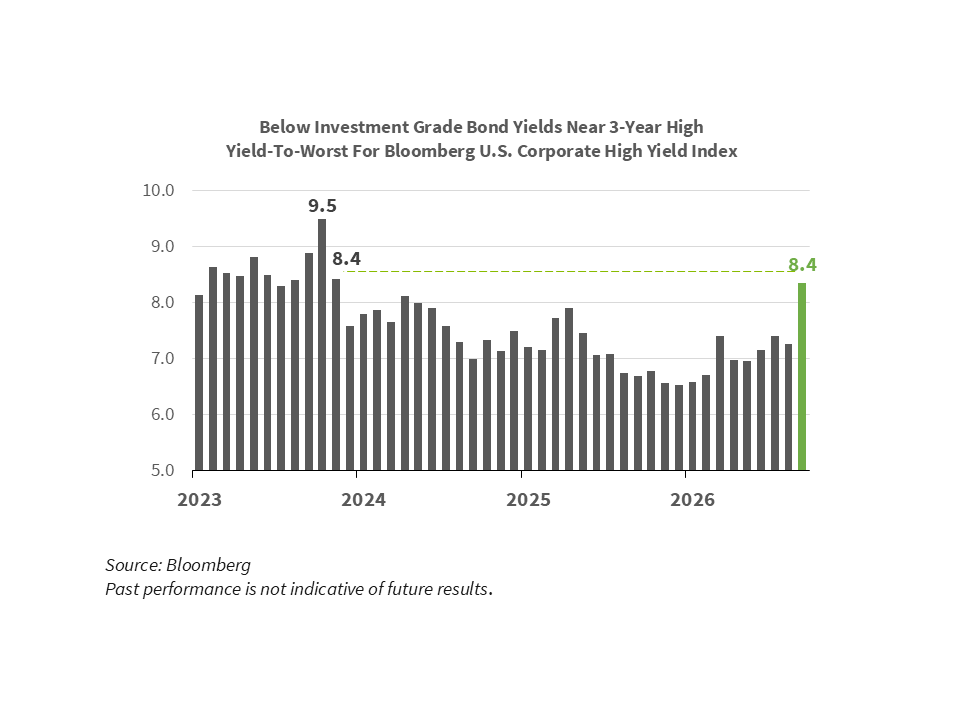
As of October 9, 2026
Related Insights
-
 Article
8 min read
Article
8 min read

-
Article