
Stocks Commentary
Stocks: Fundamentals, Sentiment, Seasonality Could Provide A Lift Into Year-End
October 2026
Market participants had a lot thrown at them in September, including continued saber rattling in the Middle East sustaining upward pressure on energy prices and the FOMC hiking the Fed funds rate for the first time since 2023, just two of the more market moving forces in play. Still, the benchmark S&P 500 index fell just 0.4% during the month while the more interest rate sensitive S&P Small Cap 600 index dropped a more meaningful 5.7% as the relentless rise in Treasury yields weighed on sentiment surrounding small cap stocks. The S&P 500 had no shortage of reasons to pull back last month, but the index finished the month less than 2% below its all-time high and rallied to a new high in early October as capital continued to rotate out of economically sensitive sectors and into secular growth due to ‘defensive’ and ‘quality’ traits.
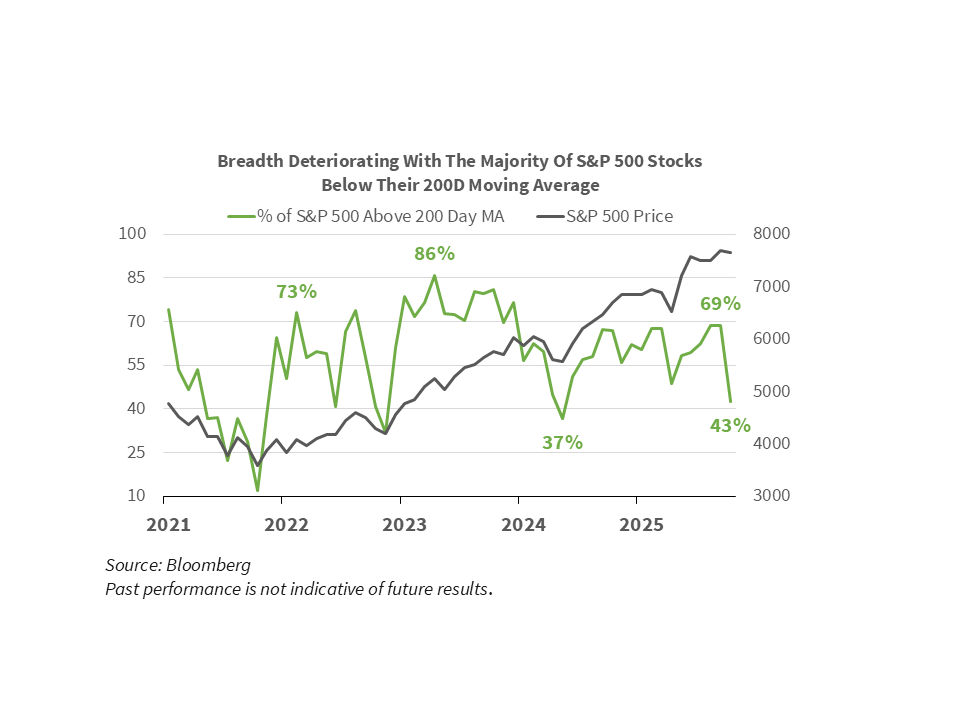
While the consumer discretionary, energy, financials, and industrials sectors each finished the month with declines of 4.5% or more, the communication services and information technology sectors garnered inflows, with the former rising 4.2% on the month and the latter 4.4% due in large part to strength out of the ‘Magnificent 7’ and semiconductor stocks. Breadth (or, participation) deteriorated during the month, but that has been a common dynamic during periods of rising interest rates. With information technology stocks again leading the pack and amid renewed investor interest in the ‘Mag 7’ – an equally weighted basket of those seven stocks rose 4.2% last month, the S&P 500 remains on firm, albeit narrow footing entering 4Q.
The start of quarterly reporting season is but one potential tailwind as investors could be eager to shift their focus away from headlines surrounding geopolitics, midterm elections, and monetary policy and back to fundamentals. At the end of September, the consensus estimate called for S&P 500 reported earnings per share (EPS) to grow 26.9% in 3Q compared to the same quarter last year, but it’s notable that the quarterly earnings estimate of around $90.86 is only up from $88.89 at the end of June. With the estimate for 3Q EPS less than $2 above where it was at the end of the 2nd quarter, even after a sizable upside earnings surprise last quarter, the analyst community may again be underestimating profit growth, and positive earnings revisions would be supportive of further upside.
While the fundamental backdrop for U.S. large cap stocks remains constructive, we could see additional positive catalysts in the form of offsides positioning/sentiment and an improving seasonal backdrop. The last American Association of Individual Investors (AAII) survey taken in September suggests that investor sentiment is not a risk into 4Q, as 46.5% of survey respondents stated they were ‘bearish’ on stocks over the next six months, well above the 31% average since the survey began in 1987. Along with investor sentiment far from being overly optimistic, hedge funds entered October carrying equity exposure that fell somewhere between ‘underweight’ and ‘neutral’ positioning, and with leverage low, this could provide fuel for any rally as there is room for these deep-pocketed allocators to lever up and chase stocks higher.
Lastly, October has garnered a reputation as being a volatile month for the S&P 500, with notable large drawdowns occurring in 1929, 1987, and 2008. But in midterm election years since 1990, the S&P 500 has posted a gain in October seven times and a loss just twice, and once we turn the page to November, we usher in what has historically been the best three-month stretch in the calendar for U.S. large cap stocks. Based on data from 1928 to the present, the S&P 500 has averaged a greater than 1% monthly return in November, December, and January, and performance has skewed decidedly in the favor of gains in years when the index is higher by a double-digit percentage entering that stretch. Stocks may continue to face headwinds from geopolitical uncertainty, elevated energy prices, and the relentless rise in sovereign bond yields across the globe, but we expect fundamentals to ultimately win-out and provide a lift for U.S. equities, particularly large caps, into year-end.
Stronger Dollar A Headwind For Foreign Stocks, Even As Fundamentals Improve. Foreign stocks were under pressure throughout much of September as the U.S. Dollar index, or DXY, rallied to close the month at 101.45, the highest level since mid-2025. Dollar strength contributed to a 3% monthly decline in the MSCI EAFE international developed markets index, with the bulk of the decline stemming from currency movements as the index was only off 0.6% when hedged back to the euro, specifically. The MSCI EAFE’s weaker return profile doesn’t align with some of the recent fundamental tailwinds in the broader index as free cash flow growth improved last quarter and once paired with lower prices, valuations improved at the margin last month. Within the MSCI EAFE benchmark, we’re seeing substantial bifurcation between the performance of cyclically oriented countries in the Eurozone with the MSCI Eurozone index lower by 4.4% in September and the technology-centric MSCI Japan index rising 1.7% last month. From a technical standpoint, the developed market index has seen selling pressure mount in the last month as downside volume spiked to the highest level since the March drawdown. This may be a sign that volatility could be with us for some time to come unless energy prices stabilize in relatively short order, which isn’t our base case given a shortage of diesel fuel into the colder winter months.
As of October 9, 2026
Related Insights
-
 Article

-
Article
11 min read