
The impact of AI: By the numbers
From computing infrastructure and energy production to real estate, the effects extend far beyond technology companies.
Key takeaways
- Massive investment in AI infrastructure is reshaping industries and could influence productivity, business investment and long-term economic growth.
- The impact of AI extends well beyond technology companies, creating potential opportunities across energy, construction, real estate and workforce development.
- While AI adoption is accelerating, investors should balance optimism with diversification and a long-term perspective.
For investors, artificial intelligence is more than a technology trend. It is an economic force with the potential to shape productivity, business investment and long-term economic growth. While no one can predict exactly how it will evolve, the scale of investment and adoption underway may provide important signals. The data below highlights where capital is flowing, which industries may benefit and what past technology revolutions can teach investors today.
A multi-trillion-dollar buildout
FactSet estimates published in August show that Alphabet, Amazon, Meta, Microsoft and Oracle are projected to spend approximately $4 trillion through 2029 on data centers, computing equipment and semiconductor capacity.
A strategic advantage?
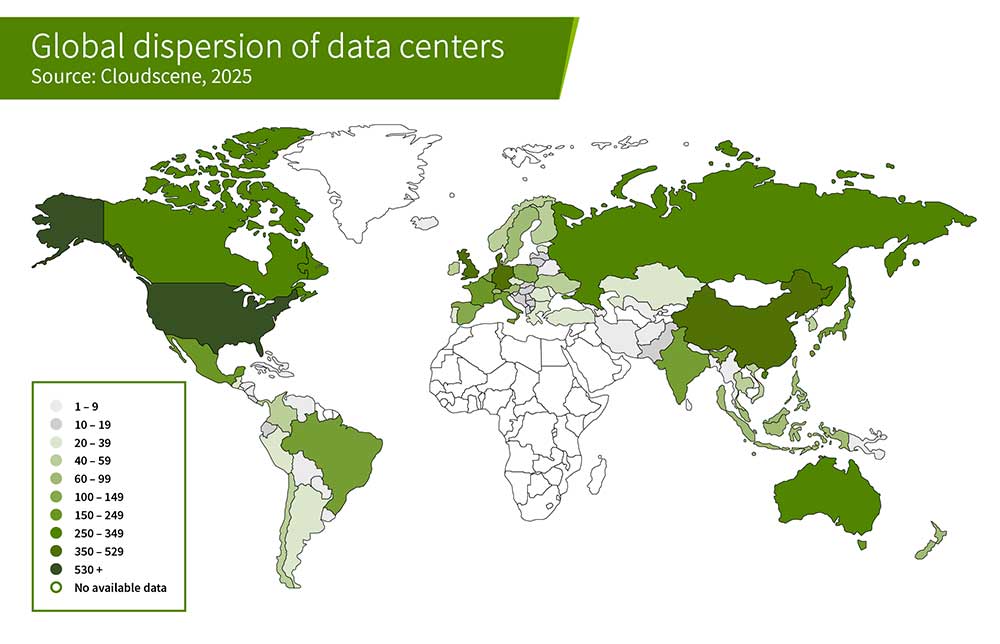
Epoch AI estimated that, as of May 2025, the United States hosted approximately three-quarters of GPU-cluster performance, compared with around 15% in China. The thinking is that this potentially gives U.S. companies an advantage because those with the most computing power may be better positioned to achieve AI breakthroughs before their competitors. A graphics processing unit (GPU) is a specialized chip that performs many calculations simultaneously. A GPU cluster links multiple GPUs to provide the computing power needed to train and run advanced AI models.
The hidden boom
Technology revolutions rarely reward only the obvious players. The AI buildout may increase business activity in related industries, such as:
- Electrical infrastructure
- Cooling systems
- Power generation
- Construction firms
- Engineering companies
- Data center development and real estate services
- Workforce training
- Productivity software
During 19th century gold rushes, some of the most reliable profits came from selling picks and shovels.
“History suggests transformative technologies create winners far beyond the companies developing them, making diversification as important as ever,” says Wealth Advisor Jason DiNozzi, CFA. “AI is not a technology story confined to the tech sector. Over time, its productivity benefits are likely to reach nearly every industry.”
The economic prize
Estimates of AI’s economic impact vary widely. MIT economist Daron Acemoglu estimates that AI could produce a relatively modest 1.1% to 1.6% increase in U.S. gross domestic product (GDP) over 10 years, while the McKinsey Global Institute estimated in 2023 that AI could provide an uplift in global GDP ranging from $2.6 trillion to $4.4 trillion annually, increasing labor productivity growth by 0.1% to 0.6% each year through 2040.
Early adopters
Stanford’s AI Index reports that generative AI reached an estimated 53% average global adoption rate within three years, a faster adoption trajectory than PCs or the Internet.
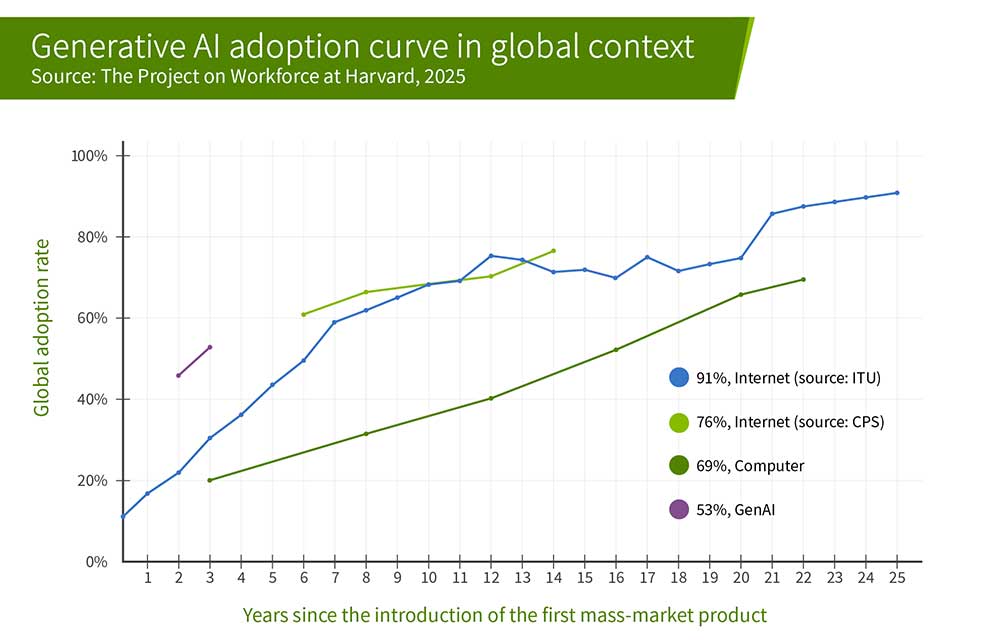
Even so, the Federal Reserve emphasized in a research note the “current gap between financial markets, which have been highly responsive to changes in the AI narrative, and aggregate output and labor market data, which currently show limited signs of broad-based transformation.”
What investors can learn from previous technology revolutions
- Infrastructure matters.
- Economic effects may extend beyond technology developers.
- Diversification remains important during periods of rapid technological change.
Challenges ahead
While AI’s potential is significant, investors should also consider several challenges. First, AI infrastructure requires enormous amounts of electricity, making power availability a potential constraint on future growth, according to the International Energy Agency. Second, copyright and intellectual property questions remain unresolved as companies, creators and regulators determine how AI systems can use existing content. Finally, expectations may be running ahead of reality. It’s unlikely every AI application will deliver meaningful productivity gains, and history suggests transformative technologies often take longer than expected to generate broad economic benefits.
“The leverage of artificial intelligence potentially provides an opportunity to further elevate the human experience,” says Bryan Koepp, Wealth Planning Executive. “However, we must be aware of potential pitfalls. These challenges include ensuring AI’s ethical use and maintaining a commitment to using technology to improve our lives. This can be accomplished through efficiencies, both known and yet to be discovered.”
Keeping things in perspective
AI is driving unprecedented investment and creating opportunities that extend far beyond the technology sector. While challenges related to energy, regulation and implementation remain, maintaining a diversified, long-term perspective could help investors participate in AI’s potential while helping manage the uncertainties that accompany any transformative innovation.
Talk to your Regions Wealth Advisor about:
- Staying up to date on the markets and understanding the latest market cycle.
- How adjusting to the impact of AI might influence your wealth plan.
Want more guidance on investing?
Our wealth management guide can help you take the first step.
Interested in talking with an advisor but don’t have one?
Find a contact in your area.
FAQ: The impact of AI
The impact of AI on the economy could include higher productivity, increased efficiency and new business opportunities. Estimates range from modest GDP gains to trillions of dollars in additional global economic activity over the coming years.
In addition to technology companies, industries such as energy, construction, engineering, data center real estate, workforce training and productivity software may benefit from growing AI adoption.
GPUs perform many calculations simultaneously, making them essential for training and running advanced AI models. Large GPU clusters provide the computing power required for modern AI systems.
Some of the risks include rising energy demands, unresolved copyright and intellectual property issues, regulatory uncertainty and the possibility that AI-driven productivity gains take longer to materialize than expected.
Previous technological shifts illustrate the importance of supporting infrastructure, the possibility of effects across multiple industries and maintaining diversification rather than concentrating solely on the most visible companies and themes.
Related Insights
-
 Article
7 min read
Article
7 min read

-
Article