
Top 10 senior scams and how to avoid them
When it comes to fraud, retirees are a common target.
If you’ve been annoyed by a scam text, email or social media message recently, you’re not alone. It’s a growing problem, with Americans losing a record-high $16.6 billion to digital scammers last year, the FBI reports.1
Fraudsters often focus on targeting older adults, especially those with significant savings. That’s why senior scams remain a costly scourge, with Americans 60 and up reporting around $5 billion in losses to scams in 2024.1
One factor behind this spike in fraud is that AI tools can ease the creation of scam messages. On the flip side, these tools also empower companies like Google to make real-time scam alerts for smartphone users.
It’s important to be aware of the most prevalent and costliest scams, and to have family conversations about fraud threats. Here are 10 common senior scams to avoid.
1. Investment scams
By guaranteeing returns or offering a “risk-free” investment option, scammers will aim to take advantage of people trying to make the most of their savings, whether via phone calls, emails, texts or social media messages.
$6.5 billion: The amount lost to investment fraud in 2024, the FBI reports, making it the costliest scam.1
Warning signs: Guaranteed high returns, pressure to act quickly, unusual payment methods requested
How to protect yourself: Be cautious of unsolicited offers. Ask lots of questions and conduct research before you invest your money. Start by checking the company’s financial statements using the SEC’s EDGAR database. Monitor your account balances and statements regularly and report any entries you don’t recognize.
2. Tech support fraud
In this scam, con artists will pose as a legitimate tech company and request personal information via email or call individuals directly and claim they need to resolve a technical issue with their computer.
$1.4 billion: The amount lost to tech support fraud in 2024, the FBI reports.1
Warning signs: Unsolicited pop-ups or calls, requests for remote access, claims of expired software or illegal content, impersonation of trusted companies
How to protect yourself: Install antivirus software on your devices and verify the email sender before clicking any links. Avoid clicking pop-ups. If someone calls you and tells you there’s a problem with your computer, hang up.
3. Romance scams
Seniors—especially widows, widowers and recent divorcees—may be particularly vulnerable to these scams which can start through social media platforms, online dating sites, or in person. The scammer will devote an extensive amount of time to wooing an individual before asking them for money to solve a problem. For example, they may pose as a member of the military deployed overseas and claim they need financial help to return to the U.S. In the worst cases, victims may end up wiring money to this fraudster repeatedly.
$1.14 billion: The amount Americans lost to romance scams in 2024, according to the FTC.2
Warning signs: An online profile that’s too good to be true, avoiding in-person meetings by saying they work overseas, a fabricated crisis, requests for money
How to protect yourself: Always stay on your guard and prioritize in-person relationships with people you trust. Educate yourself on the warning signs of a sweetheart scam, and don’t provide financial assistance to anyone you haven’t met in person. Keep in touch with family and consult with a professional if an online relationship seems phony.
4. Government impersonation scams
In these schemes, criminals may use caller ID spoofing and pose as someone from Social Security, the IRS or even a local police agency. They may also pretend to be a Medicare representative and ask Medicare recipients to share their data—which they use for fraud.
$789 million: The amount lost to government impersonation scams in 2024, the FTC reports.2
Warning signs: Unsolicited contact, threat of arrest or loss of benefits, pressure to act, requests for unusual payment methods
How to protect yourself: Hang up on suspicious calls and safeguard your personal information, including your Social Security and Medicare numbers. Review your credit report and Medicare statements regularly and report suspicious activities.
5. Grandparent or emergency scams
In these scams, criminals may target seniors by calling their intended victim and posing as a grandchild in distress. In some cases, the fraudster may scour social media profiles for information, such as the names of family members. In many cases, however, the fraudster will simply start the conversation with, “Hi Grandma, do you know who this is?” Once the senior has offered a grandchild’s name in response, the fraudster may ask for money, claiming to be in a financial pinch or experiencing some sort of emergency. In most cases, the criminal will ask the grandparent not to contact any other family members about this issue.
$2.7 million: The amount lost to emergency scams in 2024, the FBI reports.1
Warning signs: An emotional phone call that’s often late at night, claims of an emergency, requests for secrecy, unusual payment methods
How to protect yourself: While it’s a natural instinct to want to protect and help your grandchildren or other young family members, it’s crucial that you never send money without being absolutely certain where it’s going. Always call your grandchild or their parents to verify the information and be suspicious of any requests for wired funds or gift cards.
6. Sweepstakes and lottery scams
Anyone can become the target of a scam. For example, former FBI Director William Webster was the target of a lottery scam.3 He and his wife were told they needed to pay $50,000 to claim their prize: $72 million and a new Mercedes Benz. They recognized the request as fraud and as the calls became more persistent and threatening, they took action to report it. Unfortunately, what Webster and his wife experienced is a fairly common scam.
Criminals may contact a retiree by phone, email, or mail and tell them they’ve won a lottery or sweepstakes. To claim their "prize," however, they’re told they need to make an upfront payment to cover taxes or other fees. Unfortunately, the prize never materializes.
$102 million: The amount lost to lottery scams in 2024, the FBI reports.1
Warning signs: Winning a sweepstakes you didn’t sign up for, requests for payment up front, pressure to act quickly, official-looking documents or props, requests for personal information.
How to protect yourself: If you have received notice that you’ve won a prize, be on your guard. If you think you’re being targeted by a scam, do not give the scammer your money or personal information and choose not to respond.
7. Telemarketing phone scams
According to a recent YouGov4 survey, seniors make more purchases over the phone than younger adults, which makes them especially vulnerable to phone or telemarketing scams. In some cases, criminals may pose as a charity soliciting donations after a natural disaster or as a family member who needs money. With no paper trail, these scams are especially difficult to trace. Plus, once an individual falls victim to this type of scheme, other criminals may view them as an easy target and defraud them repeatedly.
$1,500: The median amount lost to phone scams, the highest per-person reported losses.2
Warning signs: Unsolicited calls, high-pressure sales tactics, too-good-to-be-true offers
How to protect yourself: Be skeptical of unsolicited calls and use tools that help you screen them. Avoid buying items from an unfamiliar company. If you’re dealing with a charity, always request that they send you written materials by mail before donating money. If you’re feeling unsure, hang up the phone and research the company or charity.
8. Homeowner and reverse mortgage scams
In some scams, seniors are offered free homes, investment opportunities, and foreclosure or refinancing assistance.
Warning signs: Unsolicited offers, promises of guaranteed income, requests for upfront fees, confusing or incomplete paperwork
How to protect yourself: Do not respond to unsolicited advertisements or sign documents you don’t fully understand. If you are considering a reverse mortgage, discuss your options with a professional reverse mortgage counselor.
9. “Smishing” or text scams
The FBI has received thousands of complaints in recent years about scam texts that claim the recipient owes money for unpaid tolls.1 Another variation is a text message that claims a package was unable to be delivered. In all cases, the texts try to trick the user into clicking a link where they will be prompted to share sensitive information, send money to cybercriminals, or even download malware. This social engineering attack is called smishing.
$129,624: Amount lost to text-based tolls scams in 2024, the FBI reports.1
Warning signs: Text message from an unknown number that includes a link, alarming language (“Your account is locked”), spoofed sender information
How to protect yourself: Don’t click on links or respond to suspicious messages. If you get a suspicious text, call the organization directly using the official phone number to verify. Explore whether your smartphone has an option to block suspected scam messages.
10. Obituary scams
In one type of scam, con artists may call or attend a funeral service to take advantage of grieving family members, claiming that the deceased owed them a debt. They may also scan obituaries to steal a deceased person’s identity. In other cases, scammers may target a recent widow in other financial scams, such as telemarketing phone scams, as they know they are going through a vulnerable time.
Warning signs: Unsolicited call or other contact, claims of unpaid bills or lapsed policies, requests for personal information, suspicious person claiming to be a friend or relative
How to protect yourself: Avoid adding too much personal detail in obituaries, such as exact date of birth or place of birth. Leave out information such as addresses and contact information to protect yourself and your loved ones.
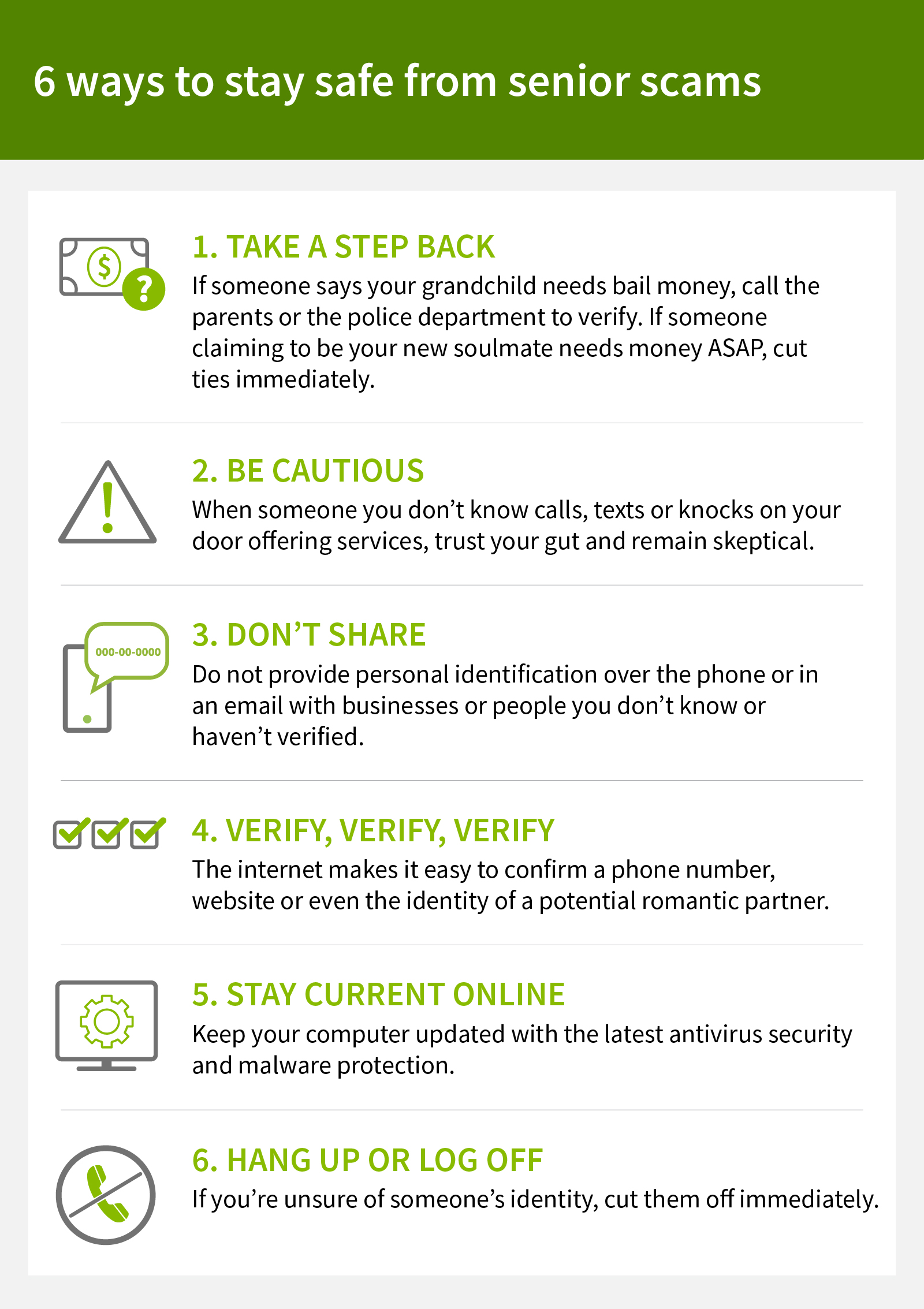
Where to report fraud and get help
If you suspect you’ve been a victim of a senior scam or any type of fraud, make sure you speak up as soon as possible. Report the incident to the FTC at ReportFraud.ftc.gov or call 877-FTC-HELP. You can also expand your efforts by reporting to other trusted resources:
- IC3.gov – The FBI’s Internet Crime Complaint Center for reporting cybercrime.
- IdentityTheft.gov – A one-stop resource from the FTC to help you report and recover from identity theft.
Additionally, contact your local police, your bank, and someone you trust.
Talk to your Regions Wealth Advisor about:
- How to stay in touch with your overall financial picture.
- Ways to keep your loved ones safe from scams.
Learn more about fraud prevention.
See the resources available at regions.com/fraud prevention or on Doing More Today.
Get started on comprehensive wealth planning.
Our wealth management guide can help you take the first step.
Interested in talking with an advisor but don’t have one?
Find a wealth advisor in your area.
Sources:
1FBI. “2024 Internet Crime Report,” April 2025.
2FTC. “New FTC Data Show a Big Jump in Reported Losses to Fraud to $12.5 Billion in 2024,” March 2025.
3FBI. “Former FBI Director William Webster Helps Foil Elder Fraud Scam,” March 2019.
4YouGov. “How Americans Prefer to Contact Businesses,” March 2025.
Related Insights
-
 Article
15 min read
Article
15 min read

-
Article
11 min read

-
Article
10 min read

-
Article
16 min read