
What could shape markets in the year ahead
Regions Chief Investment Officer Alan McKnight reveals key themes.
Key takeaways
- Diversification remains one of the most effective ways to manage market volatility and stay focused on long-term financial goals.
- While politics can influence markets, economic fundamentals such as earnings growth, interest rates and productivity trends often have a greater impact on investment outcomes.
- Artificial intelligence, corporate earnings and interest-rate policy are likely to be among the most important themes shaping markets in 2027.
As we approach 2027, investors must navigate an increasingly complex environment without losing sight of long-term goals.
For Chief Investment Officer Alan McKnight, the situation brings to mind an old Swedish proverb: “There’s no such thing as bad weather, only bad clothing.”
If you’ve ever spent hours at a winter football game comfortable in a coat while others shivered in sweatshirts, you’re familiar with the concept.
“As long as you have a diversified portfolio and you don’t take on too much risk, you could be insulated from a meaningful amount of volatility,” McKnight says. “The key is the power of diversification. It’s what helps ensure that you don’t panic.”
Moments of uncertainty can serve as a valuable opportunity to revisit your goals and ensure your financial decisions remain aligned with what matters most. “Has anything changed in your specific situation as it relates to your objectives and financial plan? Start there.”
With that in mind, here are some of the major economic and market forces McKnight thinks are likely to shape the year ahead.
Washington and the markets
With the midterm elections complete, investors now have more visibility into the makeup of Washington heading into 2027. Democrats are set to control both the House and the Senate, creating a divided government under Republican President Donald Trump for his last two years in office. This increases the potential for gridlock in legislative activity.
“Gridlock’s not bad for the markets, however. If you look back over history and see a bifurcated government, the markets have actually done really well,” McKnight says. “History would tell you that things set up well when you have a little bit of status quo and both sides are forced to negotiate.”
Markets have often historically responded positively in the year following midterm elections. Since 1950, the S&P 500 has finished higher 12 months after every midterm election, according to Dow Jones Market Data, though the path there was not always without volatility. When there is a Republican president and Democrats in control of Congress, the S&P 500 averages an annual gain of 4.9% since the 1950s, according to Carson Investment Research.
Keep in mind that past performance does not guarantee future results, and headwinds such as interest rates and ongoing debate over AI policy mean investors should focus on broader economic fundamentals. As McKnight says, “Politics matter, but fundamentals matter more.”
The global “race” for AI dominance
As governments and technology companies spend and borrow to build out artificial intelligence infrastructure around the globe, some investors have concerns. Investors are increasingly asking which countries will emerge as AI leaders and how that leadership could reshape economic growth and market performance.
“I don’t believe the hype that all jobs are going away, but I do think AI is going to make businesses and workers incrementally more efficient,” McKnight says.
AI’s impact now extends beyond business operations and consumer applications, playing a larger role in economic strength, national security and innovation. The Center for Strategic and International Studies notes that AI presents both opportunities and challenges for defense and national security and is being integrated into military operations.
There are also demographic trends that economists are keeping an eye on. With figures from the World Bank showing that the global fertility rate continues to decline, “we’re going to have to find a way to be more productive and efficient with a lower labor supply,” McKnight says. “AI will be part of that.”
Earnings growth as fuel
In 2026, particularly in the first half, earnings growth for U.S. large-cap companies remained exceptionally strong, keeping investors warm amid sticky inflation and geopolitical tensions.
That’s a lesson for the year ahead: Over longer periods, corporate earnings have historically been a more durable driver of stock returns than short-term news events.
Rate expectations
Interest rates should be viewed in historical context. McKnight says today’s interest rates are closer to historical norms than many investors realize, and there is an upside. “Many retirees are finally earning higher yields on their cash holdings again.”
Higher rates can create headwinds for borrowing and certain areas of the economy, but they might also offer investors income opportunities that were largely absent during the low-rate years following the financial crisis.
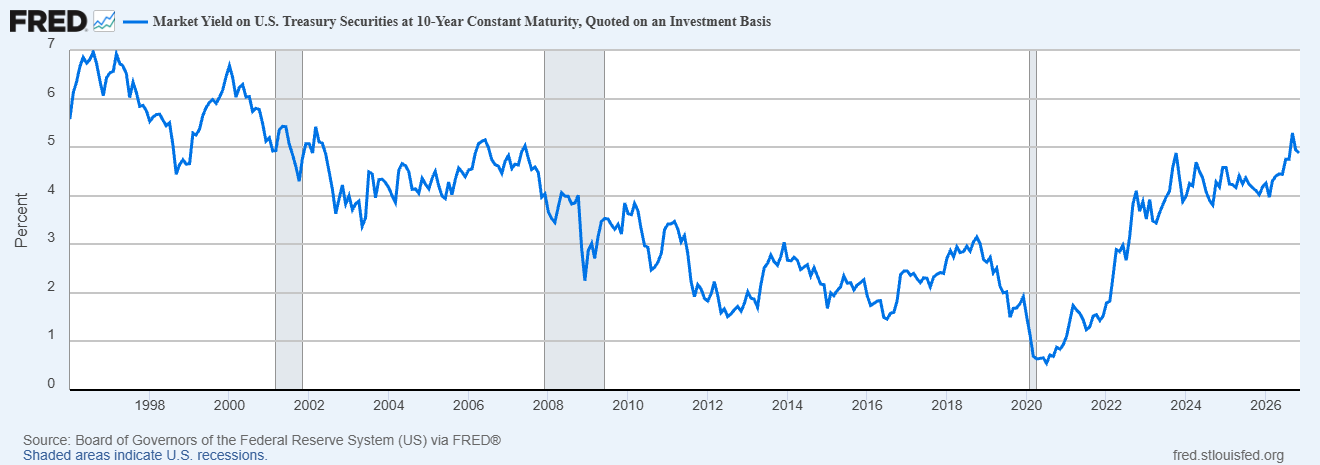
The 10-Year Treasury Yield is a widely used proxy for long-term interest rates in the U.S.
Patience and perspective
“History doesn’t repeat itself, but it rhymes,” McKnight says. “While right now it feels like everything is different, the greater probability is that things may be more similar to what they have been than we anticipate.”
Investors could face plenty of uncertainty in 2027. But successful investing is less about predicting the weather and more about dressing for it. A diversified portfolio, aligned with your goals and built for a range of outcomes, has the potential to help you stay comfortable through changing conditions.
Talk to your Regions Wealth Advisor about:
- How these themes might impact your portfolio.
- How you can make the most of your resources.
Want to get started with financial planning?
Our wealth management guide can help.
Interested in talking with an advisor but don’t have one?
Find a wealth advisor in your area.
FAQ
Key themes include the expansion of artificial intelligence, corporate earnings growth, the impact of higher interest rates and ongoing geopolitical uncertainty.
Diversification spreads investments across different asset classes, sectors and regions. This can help reduce the impact of volatility in any single area of the market and support long-term investment objectives.
AI has the potential to improve productivity, increase business efficiency and support economic growth.
Not necessarily. Higher rates can create challenges for borrowers and certain sectors of the economy, but they can also provide attractive income opportunities through cash holdings and other fixed-income investments.
Related Insights
-
 Article
7 min read

-
Article