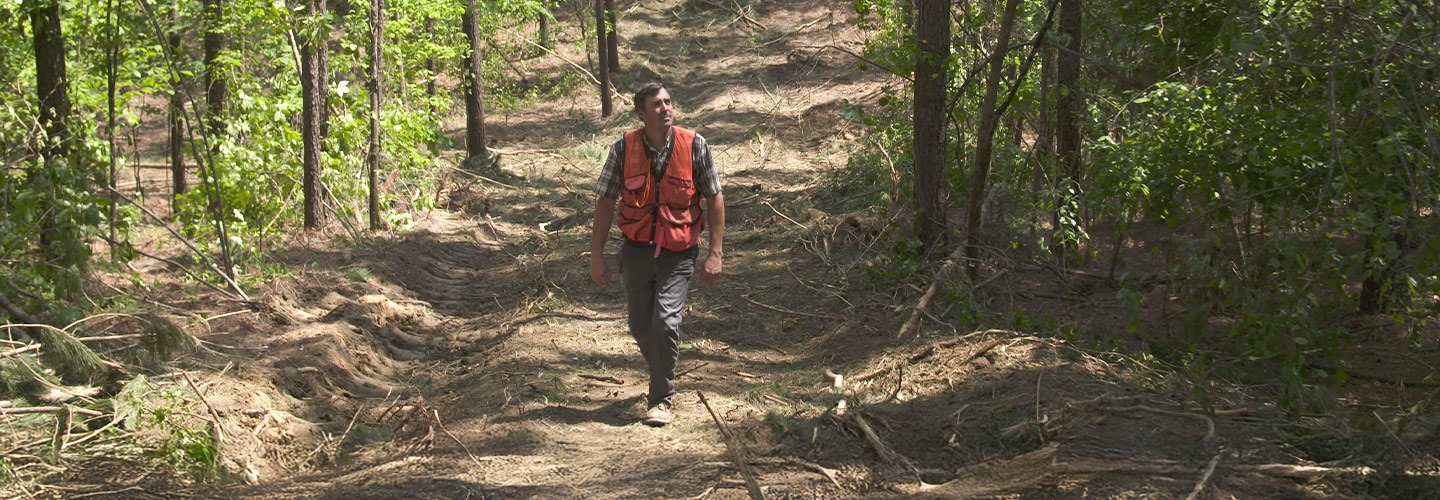
Managing a real property portfolio: From timberland and farms to real estate
The Natural Resources and Real Estate team helps families preserve and manage the real property assets that often sit at the center of generational wealth.
- A well-managed real property portfolio may help support income generation and long-term legacy goals.
- Specialized knowledge can help families navigate succession planning, property management and emerging opportunities tied to land-based assets.
- Real property assets may offer value beyond traditional uses through conservation, renewable energy, carbon initiatives and other alternative opportunities.
“My mother used to tell me money didn't grow on trees. I'm here to say: it does.”
Jim Bates, head of the Natural Resources and Real Estate group, laughs as he delivers the line. Behind the joke is a truth he has seen throughout his career: Many American fortunes have been built, in part, through ownership of real assets, from timberland and farms to mineral rights and commercial real estate.
“Either people got wealthy with real property assets, or when they get wealth, they want to own real property assets,” he says.
An avid outdoorsman who studied forestry and wildlife biology, Bates did not expect a decades-long career in finance. However, his knowledge helps him guide his team of 60 professionals serving 19 geographic markets as they work hand-in-hand with Regions Wealth Advisors and Trust Officers. “Whatever the asset, we put the landowner's best interests at the forefront of everything we do.”
Protecting family legacies
Passing the torch is often a sticking point. The situation may be that Dad can't continue to manage the farm, but the family doesn't want to sell it. Or that the family members overseeing mineral interests are ready to retire, and the next generation has no desire to manage the operation.
“That’s where we can step in,” Bates says. His team of foresters, farm managers, geologists, landmen and certified property managers helps clients protect, manage and pursue improved stewardship and value of land-based assets.
Real property portfolio management in action
To illustrate, Bates explains how the team helped a couple who owned multiple residential properties, a warehouse and other real estate assets managed by third parties. As the husband’s health began to decline, he realized his wife would need support managing the complex portfolio. The couple had the Regions team step in as property manager and advisor.
“We identified some maintenance issues and addressed them,” Bates says. Soon after, a long-term lease was negotiated with a luxury automotive dealership. The property evolved into an $11 million asset generating roughly $11,000 per month in rent.
“We're often there at a time of need for successors and heirs. We can step in, manage the asset and work to help preserve both the income stream and the family’s legacy.”
Unlocking hidden value in real assets
Bates says the team thinks beyond the dirt. “It’s not just traditional timber and farmland. We’re helping clients evaluate alternative asset management opportunities as well.”
This includes negotiating and reviewing wind, solar and carbon lease agreements, wetland mitigation banking and more. The team understands that land may have value for conservation, renewable energy, carbon initiatives or other emerging uses.
“We make sure we’re staying on the cutting edge to better serve our clients.”
Specialized guidance
Sometimes the objective isn't total return. “A timberland client may want to improve wildlife habitat and grow bigger deer. We can help them pursue those goals,” he says.
Bates says technology is transforming land management. The team uses drones and advanced photogrammetry tools to monitor forest health, improve accuracy and help clients make more-informed decisions about their properties. This technology is used to make resource management safer and more accurate.
For Bates, success is about more than what’s growing on the land. It’s about helping families protect what matters most and prepare for the future.
Money may not literally grow on trees, but generational wealth often has deep roots. By helping families preserve and manage real property assets, the Natural Resources and Real Estate team works to ensure those roots remain strong for generations to come.
Timberland
Farmland
Mineral rights
Assets under our care
- 700,000 acres of timber
- 100,000 acres of farmland
- $500MM in real estate properties
- 45,000 oil and gas wells
*As of Jan. 1, 2026
Services
- Timber management
- Farm and ranch management
- Mineral land management
- Commercial and residential real estate
- Alternative asset management
Talk to your Regions Wealth Advisor about:
- How the Natural Resources and Real Estate team can help you with your real property portfolio.
- Ways to make the most of your land and real estate.
Want to get started with financial planning?
Our wealth management guide can serve as your starting point.
Interested in talking with an advisor?
Find a wealth advisor in your area.
FAQ: Real property portfolio management
A real property portfolio is a collection of real estate and land-based assets owned by an individual, family or entity. It may include timberland, farms, mineral interests, commercial properties, residential rentals and other income-producing real estate.
Effective management historically helps preserve asset value, support income-generating opportunities, improve operational efficiency, support succession planning and identify strategies for long-term growth.
Common challenges include lack of management experience, succession planning concerns, coordinating multiple stakeholders, property maintenance and evaluating future uses for the assets.
Professional managers can oversee operations, coordinate maintenance, negotiate leases, manage resources, evaluate new opportunities and help ensure assets align with a family's financial and legacy goals.
Yes. Many properties can support alternative opportunities such as solar development, wind energy projects, carbon agreements, conservation programs and wetland mitigation banking, depending on the specific characteristics of the land.
Technologies such as drones and photogrammetry can improve monitoring, increase management accuracy, enhance safety and provide valuable insights that help landowners make informed decisions about their properties.
Related Insights
-
 Article
7 min read
Article
7 min read

-
Article
14 min read

-
Article
12 min read