
Does agentic AI spell the end of software?
Generative AI has been the biggest catalyst for the technology sector over the past two years. This may continue into 2026.
Generative AI has spurred significant investments by hyperscalers. However, not all subsectors have been the beneficiary of these investments. While the semiconductor subsector has been the primary beneficiary, the software subsector has been negatively affected. We will look at the factors affecting this negative sentiment.
Despite the periodic sell-offs due to fears about an AI bubble, SOX, the Philadelphia semiconductor index, has outperformed the broad markets over the past year. On the other hand, the software subsector (IGV, software ETF) has been under pressure due to fears that generative AI is going to replace products from traditional software/SaaS vendors (Figure 1). The sell off has been more pronounced as more sophisticated AI tools have been released.
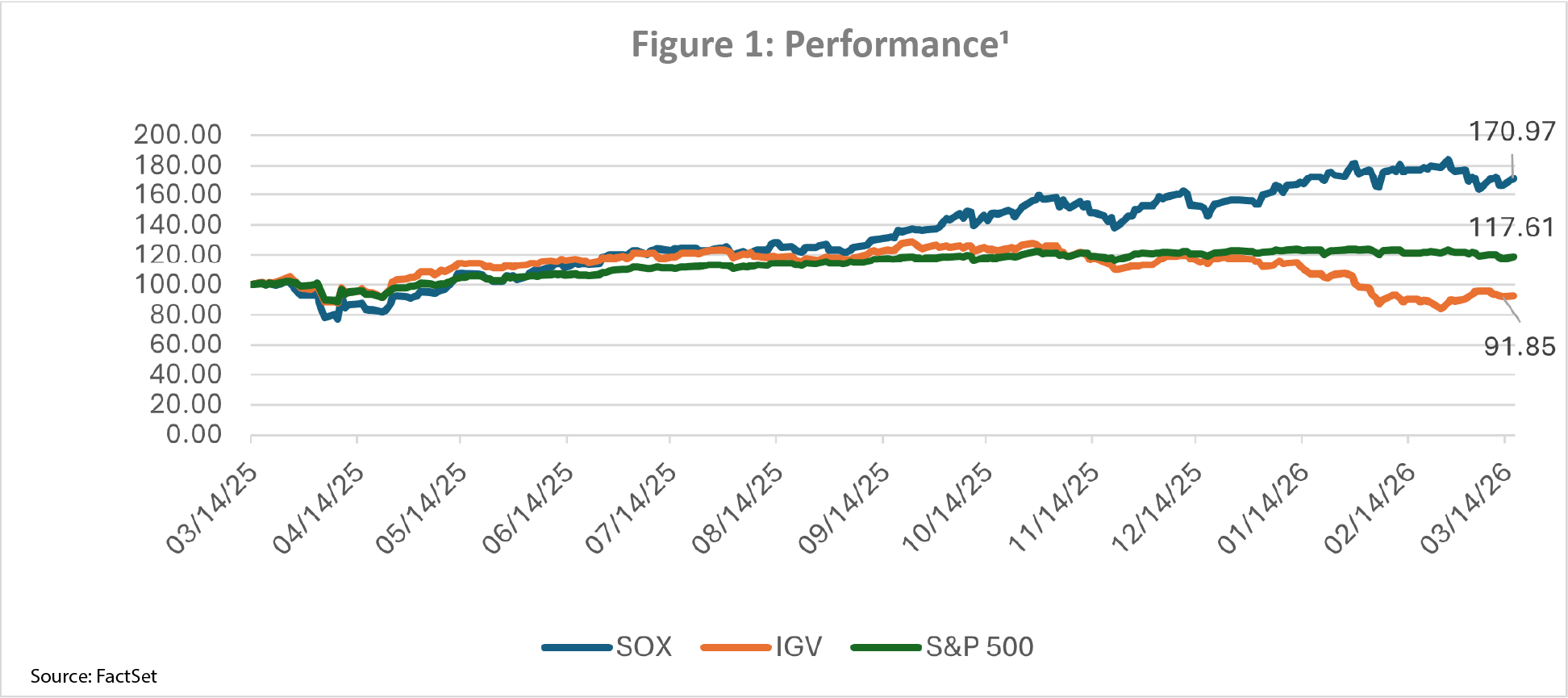
For example, Anthropic’ s Claude Code, an AI powered coding assistant which can be used to automate development tasks, has been available since September 2025.
There are several reasons for this underperformance.
- Competition: AI will allow new companies to develop application software and compete with current/legacy SaaS vendors. This could result in pricing pressure and eventually margin pressure.
- Seat Pressure: Currently most software vendors use the subscription model for their products. These models are typically priced per user. As use of AI increases, companies may become more efficient and need less people. This could lead to lower subscription rates, thus slowing revenue for software vendors.
- Replace: Eventually, AI could replace current enterprise application software. Due to the ease of writing code, companies could develop their own software rather than continue to subscribe to outside vendor products. This could affect revenue growth for enterprise software companies.
Currently, enterprise software acts as a System of Records (SoR) where data is created, stored, and managed. This SoR is needed to maintain accuracy of the data across the enterprise and meet all compliance regulation. A SoR is typically used for back-end operations and does not have a specific timeline. Examples include Customer Relationship Management software (CRM), Enterprise Resource Planning software (ERP) and Human Capital Management software (HCM).
Generative AI is opening a new frontier by developing agentic AI to become a System of Action (SoA). A SoA focuses on data automation and can complete tasks and drive workflows. For example, generative AI can be used to write and test computer code and thus accelerate development cycles. Generative AI can also be used in supply chain management, where agentic AI can manage inventory levels by placing orders based on predicted demand. Thus, SoA is expected to enhance productivity.
The impact of generative AI in legacy SaaS vendors will vary. Legacy vendors have access to all of their customer data and data is the key to developing any AI models. While consumer data may be relatively easy to access, access to enterprise data is limited. In general, there are some key factors that can influence the impact of AI on software companies.
- Ease of automation: The degree to which any processing can be automated is one of the key factors in determining if the corresponding software can be automated. This will depend on the data used (general vs. proprietary), and complexity of workflows. Thus, use of standard data and repetitive tasks could be the most vulnerable to AI adoption.
- Moats: Software that uses proprietary data and is deeply embedded in enterprise workflows may be more difficult to switch and may exhibit a lower exposure to AI adoption. SaaS companies that own enterprise data, the compliance model and the underlying logic for the enterprise appear to have strong moats.
Using these criteria, SaaS companies that have non-critical products and rely on manual content creation have low switching costs where AI adoption has potential to have a greater impact. Software that manages horizontal workflows like email drafting, handling and summarization, planning and research may be ripe for agentic AI. Business analytics software for data query, trend generation and application development software for coding, testing, and documentation could also be at risk. Similarly, some functions of customer relationship management (CRM) software for sales, servicing, and marketing and of Enterprise Resource Planning (ERP) software, like supply chain software, could also be replaced by AI.
SaaS companies that own enterprise data and are deeply embedded in client platforms are likely to be least affected by agentic AI. These companies are likely developing or have already developed agentic AI additions to their current products. They are also likely considering licensing agreements with software companies focused on generative AI, like OpenAI and Anthropic, for further development of agentic AI. This will help them maintain market share.
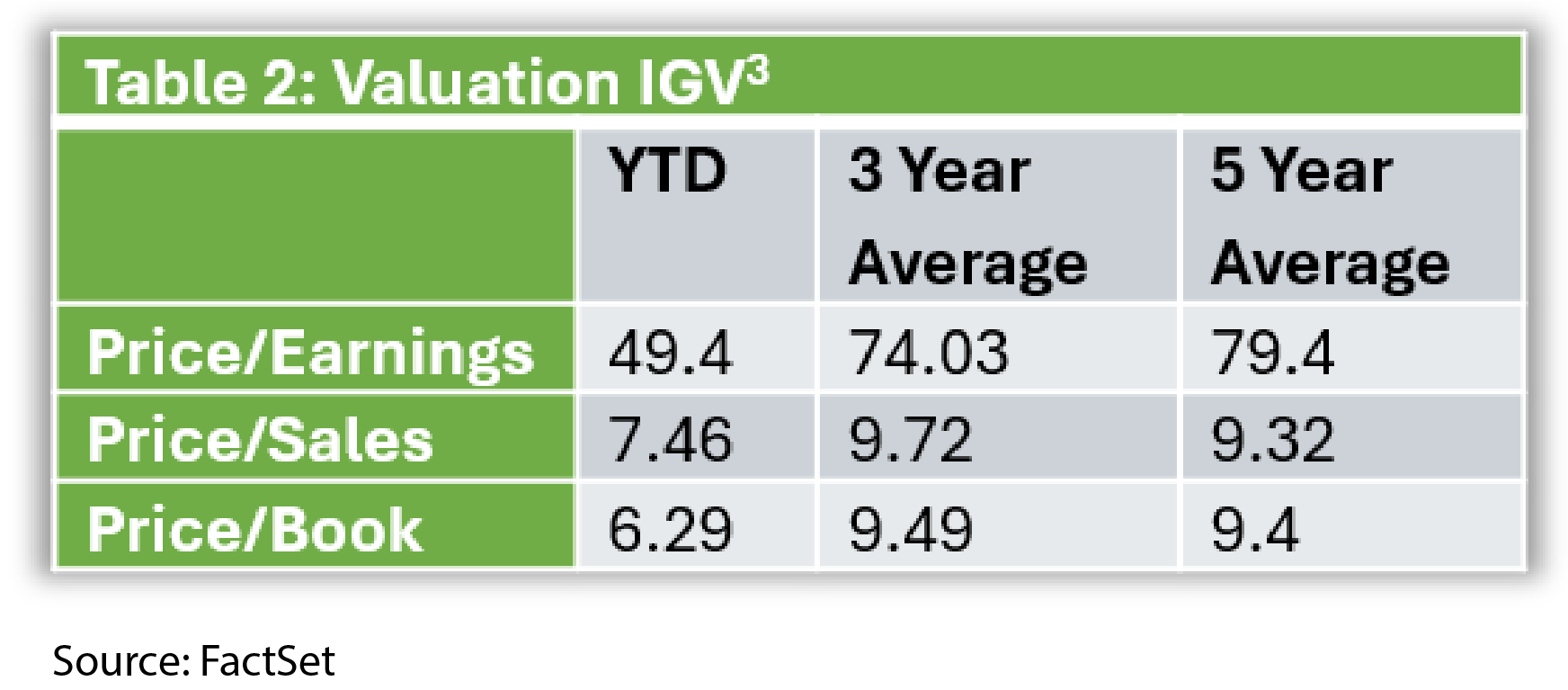
As a result of the sell-off, valuations of SaaS companies has come down significantly (Table 2). However, due to the development of agentic AI, it is important to be selective in investing in this space.
Summary
Generative AI has spurred significant investments by hyperscalers to build data centers, and the semiconductor subsector has been one of the primary beneficiaries. However, the software subsector has been negatively affected due to fears of increased competition, reduced demand due to smaller workforce and risk of substitution by agentic AI. The impact of generative AI on legacy software vendors could be determined by the ease of automation and the footprint of the software within an enterprise. Thus, non-critical software products that rely on manual data entry could be most at risk, while software products that are critical to an enterprise and are deeply embedded across various platforms within an enterprise may have less risk. SaaS companies that own enterprise data and are deeply embedded in client platforms may maintain market share by integrating AI into existing products. While valuations have come down significantly, it is important to be selective in investing in this space.
Talk to your Regions Wealth Advisor about:
- Your preferences for regular meetings about your portfolio.
- How to receive Regions Asset Management weekly market commentary.
Related Insights
-
 Article

-
Article

-
Article
9 min read